Tuesday, July 5, 2016

Kate pulls the hay wagon.

Make Hay While the Sun Shines

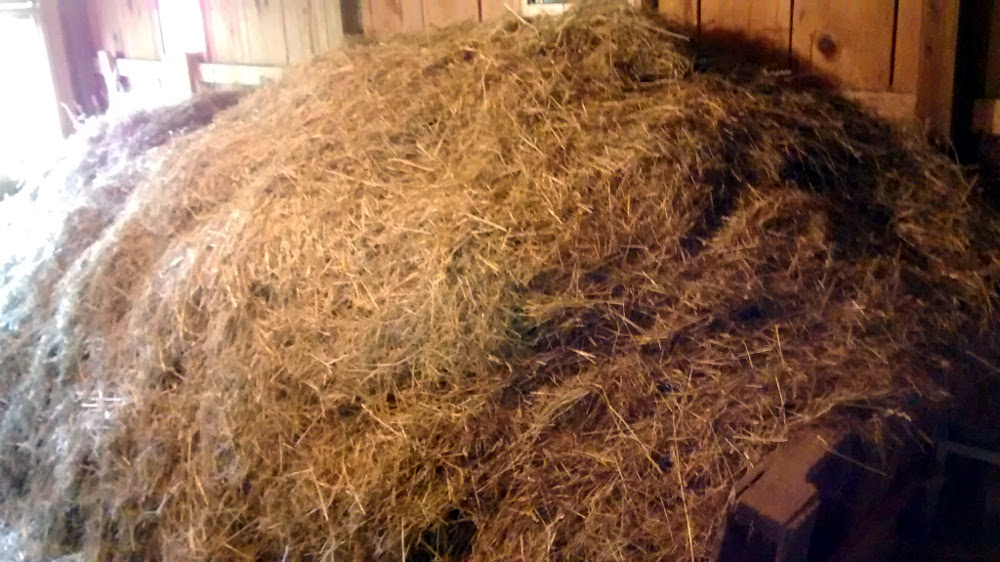
The steady rhythm of the seasons has always been a joy to my soul -- the welcome return of light, heat, and growth of summer.  The scent of new-mown hay and the feeling of security against the winter months that a fat load of hay creates.  On Hawk's Hill, we make hay the simple way -- Without hay ballers or balers, my husband mows it, rakes it with an implement he crafted himself, and then we load it onto a hay wagon with the new tractor bucket and pitchforks.  Then into the barn we fork it into one huge pile.

We made hay the week before Independence Day on a hot, sunny afternoon.  Come Thanksgiving, when our oldest daughter returns home from college, she and I will find ourselves moseying out to the barn to check on the laying flock, then plopping ourselves down in the warm hay pile to take in the quiet sounds of the barn-- the hens scratching and feeding, the wind in the eaves.  Time will open up to hear her thoughts, her latest stories, and the eternal sense of connection with each other and nature will spring up gently within us.  That is what I think of when I make hay in the sunshine.

Of course, the practical reason we make hay is to provide clean bedding for the hens in the winter.  They will pick through it for seeds and other tasty bits, too.  But the hay makes a clean floor covering, and a cozy stuffing for nest boxes to cushion the birds and their eggs.
The growing hay pile nearly reaches the ceilin.


David scooping hay.


 Have you ever wrapped yourself in a woolen cloak and tucked down into a pile of clean hay?  The scent of the summer meadow rises up around you, your body warmth is reflected back to you and you feel the rare sense of delicious warmth in the midst of the bitter weather.  Yin and yang.  The heat and stickiness of making hay -- sweat running down your brow and stinging your eyes, prickly grass bits lodging down your shirt, the sun pressing into your body -- mingle with the remembrance of Novembers past and the delight of warmth in the cold, and nearness to nature and kin.  Its these simple earthy pleasures that make living on Hawk's Hill a gift from God.

Here's hoping you are enjoying the heat of this season and storing up memories for winter's fireside.
Betsy


Monday, April 4, 2016

Spring Photo Post

 Indoors and out, spring is springing on Hawk's Hill. Spring showers have brought rainbows.
Kale, cabbage, broccoli and Brussels Sprouts grow inside our solar heated greenhouse (no additional heat).

 We have started plowing beds in preparation for planting greens, beets, carrots, broccoli, and onions.
Indoors, the plant stands are up and going in the south windows of Soulstice, our solar home.  Onions and broccoli starts wait for the winds to diminish so they can get hardened off outdoors before transplanting in the garden.  Above, tomatoes, peppers and eggplant seeds sprout in flats.

Wishing you all spring within and without!
Betsy

Sunday, March 20, 2016

Vernal Equinox, part 2

Out in the nourishing darkness tonight, I closed up the chicken's hatch to their outdoor pen as the snow pelted the lush spring grass.  Overcast skies blotted out any moonlight, and I made my way attended by the beam of a very small flashlight. A soft purr of concern rose up from the flock as soon as I arrived outside the barn, and I calmed my birds with a whispered assurance, "Just me."

 Inside the dark barn, I collected eggs from under sleeping hens, my hand slipping between the hay nest and downy hen feathers, warm as an antique quilt.  As I gathered the eggs, the hens' wings curved around my hand in a practiced move, trying to gather back in the wayward eggs. Had I rooster right now, I'd let those eggs lay where they are.  But it's all ladies in the flock.

Back outside, my dog and I stopped to experience a snow squall ride in to our hilltop from the far ridge.  A dusky cloud of snow swept over the landscape, blotting out the little I could see of the fields and fencerow trees this dark night.  My dog and I paused to drink in the cold air, to feel the frozen prickles of snowflakes on our noses, and hear that lovely singing sound snow makes as it lands on open ground all around you. The simplest prayer is just to listen.

 Good bye winter.  Goodbye snow.  I carried the basket of warm eggs back into the buttery light of the house to where the broccoli and onion seedlings grow under lights.

Welcome spring!
Betsy

Happy Spring Equinox


A snowy first day of Spring follows a mild winter, and finds Hawk's Hill decked in green grass and blooming daffodils.

Earlier in the week, we dug the last of last summer's potatoes. A full pantry and a bounty of spuds last fall led us to experiment with leaving 5 or 6 rows of potatoes in the ground.  We used the earth as our refrigerator over the winter.  For the most part it was successful. The potatoes held indoors in pantry storage have grown long sprouts and gone rubbery. Out in the good earth, we dug up about a bushel of solid, unsprouted spuds. About half of the overwintered potatoes in the garden had gone mushy or frozen. We harvested the other half.  As I write, a pot of Kennebec potatoes boils to make mashed potatoes for dinner. Yum!


Giant Kennebec potatoes 


Natascha golden roasting potatoes and Banana Fingerlings


And the hens are laying, providing me with a favorite springtime treat -- egg salad sandwiches.  Here's a pot of eggs recently boiled.  I love the variety in colors in the brown eggs -- some rosy, some tan, some earthy brown.  Soon, the hens will leave their wintering home in the barn, and roam the fields again, eating fresh green grass.


Wishing you all balance and a return to contact with Nature at this Spring Equinox!
Betsy

Tuesday, January 5, 2016

Blessings of a January Day


Part of the blessing of these winter days is the quiet openness that extends out on a crystalline morning.  The January cold has stilled our outdoor work, and we simplify, move inward, and tend to hearth and home.  Our spirits rise listening to the murmur of a pot of chicken soup simmering on the stove, watching fine snowflakes drift down from scattered fluffy clouds, or witnessing the sun's brilliance as the clouds part and spill its light into the landscape.  We emerge from the rush of the holidays and return to the stillness of nature, newly aware of the balm and spiritual connection we receive there.


Though seemingly still, the landscape is not empty, as a lively flock of chickadees flitting from tree to tree through the woods reminded me on my morning walk, their spirited voices breaking the morning quiet like a magic spell.  Leaving the woods, I passed last summer's potato bed and the permanent planting of Jerusalem Artichokes, and smiled at the thought of these unseen caches of food still lying underground on Hawk's Hill.  On my way back up the hill to the house, I stopped in the garden, retrieved a spading fork from the tool shed, and tramped down to the bed at the bottom of the garden where our winter carrots lie, kept crunchy and sweet by the cool earth.  Finding a row label marked "July 5 Scarlet Nantes,"  I shoved the digging fork in alongside the ferny tops.

I pried the fork back, unearthing the golden booty.  Before I slid the carrots from their good earth, I squatted back on my heels as people have done down the millenia. I looked up at the sky and took in the beauty of nature around me for one grounding moment before saying, "Thank you, Carrot Nation, for feeding the people."  Slipping the slender taproots from the earth, I brushed the dirt off and collected them in a plastic grocery bag I pulled from my coat pocket.  A few more forkfuls of earth yielded enough carrots for our family's needs for the next week.


I have taken to saying this simple prayer of gratitude as I collect eggs from the hens, pluck leaves from the kale plants, even when we plowed out long rows of potatoes earlier in the year.  I learned it from my friend, Brad Silberberg, director of The Mesa Creative Arts Center,  who teaches Native American spirituality and often works alongside us on the farm.  I find the prayer immerses me in gratitude in the moment.  And the more gratitude I express, the more abundant my life feels.

Some of the carrots ended up in that simmering chicken noodle soup we ate for dinner, the rest got scrubbed up and tucked in the refrigerator to be eaten out of hand.  We found long ago that carrots taste best when just pulled from the earth, and that within a few days, their sweetness diminishes.  So, now we're hooked, and we enjoy freshly dug carrots as one of the perks of winter's quiet days.


As to the nuts and bolts of carrots, we start our winter carrots around Independence Day, and plant a row on either side of a drip irrigation line.  One carrot seed is planted every 2 inches down the row.  I make a shallow trench with my finger, place the seeds in, and cover them with fine soil.  I've tried using an Earthway planter, but find the job is best done by hand.  It takes a while, but if you have a partner to chat with, the time goes quickly.  My carrot planting partner is our oldest daughter, Sarah.  A Creative Writing major in college, Sarah spins tales for me, sharing the latest developments from her story worlds --  fine entertainment for a simple task.

Carrots may take up to 3 weeks to germinate, so you have to keep the rows weeded and the ground moist during that time.  Once the ferny carrot tops begin to develop, they will out-compete the weeds, and all we do is keep watering (we try to keep the weeds controlled between rows).  And, of course, we harvest.  And offer prayers of gratitude.

At the end of the day, after my harvest and before the night's temperatures plummeted under the clear blue sky, I covered up the remaining carrots with leaves to blanket the carrots' shoulders from the bitter cold.  Voles like to burrow in such a natural "quilt," and eat whatever lies above ground, so I usually wait to mulch until temperatures drop into the teens or below to hold off the little thieves.  At this point, I figure the voles will get some of the tops, but the rest will be saved for us to enjoy.

May these cold January days also bless you with quiet openings and abundance,
Betsy


Saturday, December 26, 2015

Charging up the Permaculture Garden


El Nino and Global Climate Change have given us a warm winter and boosted recent temperatures into the 50s and 60s. Christmas felt more like Easter.  We have put the balmy winter to use by keeping our hens out on pasture later than in any year to date.  It's a Hawk's Hill record.  This morning, we moved the hens to their winter quarters in the barn because I wanted to make sure that they got a chance to eat the weed seeds, bugs and grass that had grown up in our permaculture garden -- the fenced yard behind the barn -- and to give them time to recharge the garden with their manure.
The hens' winter run behind their barn enclosure.  The chicken tractor is parked for the winter behind their yard.


For those of you who are not familiar with permaculture, it's a radically different take on farming that tries to emulate nature, reduce labor inputs, and maintain optimal harvests while eschewing pesticides and building organic matter in the soil.  Chickens make great permaculture partners, as free soil workers.  This morning, the hens took to the work with their characteristic excitement at landing on fresh pasture.  Contented clucking and enthusiastic scratching through detritus was interrupted with low chuckling when one hen unearthed a worm or bug and gobbled it down before another bird could snatch it away. The day was filled with the thrill of such little discoveries for the ladies.
Our little bio-tillers show up for work.
One permaculture principle is to plant your gardens near where you live and travel every day so you can keep an eye on them.   Last summer, I noticed how I walked to the barn for chicken feed every day, right past a nicely fenced, fertilized patch in open sun.  It was a "Duh!" moment.  Summers find us stretched to the limit for hands to weed and harvest our gardens, and last year, we added two new potato patches to the farm while one of our helpers -- our daughter Kate -- left for a month to study in Japan.  Still, I couldn't help but make use of a plot of earth that would otherwise just fill up with weeds.

I planted Kentucky Wonder pole beans, Vilms paste tomatoes, Tromboncino squashes and Green Apple Cucumbers along the fence, added Benning's Green Tint patty pan squash and Howden Pumpkins to the center of the plot.  Finally, I tucked in a single sunflower my friend Mary gave me for Mother's Day.

The garden's water source.
The hens' winter quarters in the permaculture garden.
I mulched around the squashes with old hay and leaves to keep the produce off the ground and to reduce weeds.  Of course, grasses and lambs quarters grew up in the space alongside the food plants, so the plot wasn't picture perfect.  I watered occasionally, filling a large bucket (blue one in the photo) set in a wagon, with water from the rain-barrel bathtub around the corner.  My goal was to spend no time weeding and just a little time watering.


And it worked.  The plot produced a lot of food -- bushels of squashes and more pole beans than I could harvest.  We picked pumpkins for Halloween decorations, squash blossoms for frying, and tasty plum tomatoes just to eat out of hand.  I still have a couple of tomatoes in my kitchen that I found just before the first frosty night, and several long, curled Tromboncino squashes flop out of their bushel boxes, waiting to be roasted in the oven like Butternut Squash.

What made it work?  The hens' efforts over last winter scratched the land clean of weeds while adding their fertilizer to hay I laid out over the snow for them.  We grew plants vertically to keep them off of the ground and to aid in my watering efforts.  I could haul my water wagon around the outside of the plot, pouring water from a bucket or watering can at the base of the fence and water the majority of the plants' root area.  Super fast and simple.  As I passed by the fence, I could check quickly for squash bugs on the climbing Tromboncino squashes or Mexican bean beetles on the pole beans.  I spent less than 10 minutes a day on average tending the plot after the original planting was done.

The girls excitedly cleaning up the permaculture garden.
Now the hens are back to their work tending the permaculture plot, tearing up some leaves I tossed in the enclosure this autumn, fertilizing, eating insects, cleaning up weed seeds, scratching the grass roots out and tilling all the organic matter back into the earth to prepare for next summer's permaculture garden.  The only question is what to plant next year?  A Three Sisters garden of corn, pole beans and squash would work, but good gardening practices require rotating new crops in for a 3 year cycle.
Potatoes would be out, because any leftover spuds could poison the hens in the winter (chickens can't eat raw potato skins).  Onions and garlic must grow undisturbed over the winter, so they would be out.


A grain like wheat or oats would work, as would dried beans, lentils or field corn.  Sunflowers grown for seeds would be a good choice, and the seeds that fell on the ground would feed the hens when they arrive next December to clean up.  Melons would favor the fertile soil in a wet year.  Peppers & eggplants seem a little fussy to take the weed onslaught, but could be grown with enough mulching.  Cherry tomatoes on the fence would be ideal.  But for the best crop rotation, a cover crop of daikons in the spring would break through the clay soil layer and pull up minerals from the subsoil, followed by summer cabbages would be the best move.  I can imagine rows of fat cabbages lined up where the hens now scratch and peck.  The way I farm, it's likely to be slightly less organized and more serendipitous.

The best part of the permaculture garden for me is feeling in partnership with nature and my little flock of hens in tending this earth patch that I am lucky enough to call home.

Wishing you all a New Year abundant with nature's blessings!
Betsy

Ducking back into the barn to lay an egg.

If you are interested in reading more about permaculture, my favorite book of late is The Resilient Farm and Homestead by Ben Falk, but there are plenty of books, sites and videos out there.  This is the perfect time of year to start making plans for your garden and homestead.


Tuesday, August 18, 2015

This Spud's for You!


Sitting outdoors at my picnic table and drinking hot tea this overcast August afternoon, the sun’s warm rays reach through the cloud deck and warm my skin till sweat beads on my lip. My mind, dulled by the fatigue of late summer, needs the caffeine boost to keep alert as I peel a half bushel of potatoes.  My steel paring knife cuts through each hard white potato, cleaving off the skins juicily and shedding the peels into an antique enamel pan at my feet.  Another white potato cleaned of its dusty cover, drops into a massive, speckled stock pot.  Soon, I will take the cleaned potatoes into the kitchen for a last wash, a chop and ten minutes of boiling to prepare them for canning.  

The bounty of spading fork-speared, bug-bitten, green-skinned second-quality potatoes lying about the house will not last for more than a week or two before going soft and stinky.  Better pare off the bad spots and can them up now to line the shelves of the pantry for winter’s quiet, cold days.
Peeled potatoes ready to be quartered and boiled.


Simmering Kennebec potatoes before hot packing in jars and canning.


Though the late heat has finally arrived, I can feel the earth swinging steadily in its orbit towards fall.  The shorter days, the fattening apples, the ripe, orange pumpkins lying among dry grasses announce  autumn’s dawning.  And that makes the potatoes in my stock pot feel like money in the bank against winter hunger.


A dozen quarts of pressure-canned potatoes stand ready for winter.


At harvest time, I like to imagine what early people would think of the box after box of tubers the potato plow unearthed.  After David’s tractor has pulled the long potato furrows and turned up hard, fat spuds -- goose-egg sized Red Gold and Natascha golden roasters, or long Banana fingerlings, or Yukon Golds as big as a man’s fist, or massive Kennebec white potatoes almost as big as my foot -- I calculate the wealth in calories we possess.  At the end of each 25-foot row of our potato patch, we fill a bushel box, netting roughly 20,000 calories of energy.  More for red-skinned potatoes (440 calories/pound for russets), and less for white (319 calories/pound for white, boiled).  At 60 pounds per bushel, that’s between 19,140 and 26,400 calories in a box.  Looked at another way, the USDA defines a serving of potatoes as a single, half-pound potato, so that 60 pound box contains 120 servings of potatoes -- mashed, roasted, baked or fried.
Our first harvest of Natascha Golden Roasters
These white potatoes will serve us this winter, but my favorite summertime potato recipe is for roasted potatoes, using the special golden roasters we grow each year:


Hawk’s Hill’s Favorite Roasted Potatoes

1 quart roasting potatoes
1-2 Tbsp extra virgin olive oil
salt and pepper to taste

Preheat oven to 450 degrees F. Pour olive oil onto large cookie sheet.  Wash and dice into 1” cubes, Red Gold or Natascha golden roasting potatoes.  Or slice Banana fingerlings lengthwise.  Pat dry.  Place, cut side down, onto cookie sheet.  You may brush tops with more olive oil.  Sprinkle on salt to taste.  Bake for 15-20 minutes, until tines of a fork insert easily into the potato pieces.  Serve immediately.  We make a dinner out of chili beans and potatoes, with sauteed greens, summer squash or green beans on the side.  Quick, hearty and delicious.


Bon appetit!
Betsy

Monday, July 20, 2015

Market Night Dinner


We arrived home after selling produce and baked goods at Weirton Market tonight with a zucchini, a giant beet, and a box of onions leftover from market sales.  Also a collection of fresh herbs and two quarts of French filet beans.  Tired from the day's labors, and wanting something healthy for dinner, I shredded the beet, zuke and an onion, chopped basil, oregano and cutting celery leaves, and mixed it all with 6 fresh eggs and a cup of whole wheat flour to make veggie pancakes.  While the pancakes fried in an iron skillet, I sat down to snap green beans.

 Dinner was sweet, herb-y vegetable pancakes alongside green beans sauteed in olive oil with a few squirts of soy sauce for flavor.  A delicious, satisfying and quick meal that didn't take a lot of thinking or waiting.

Try your own mixture of vegetables.  This time of year, it's a good idea to have some go-to recipes that work well for a variety of vegetables.

Vegetable Pancakes

6-8 cups mixed veggies: summer squash, beets, carrots, onions, potatoes and/or fresh corn sliced off the cob
5-6 eggs, scrambled
1-2 cups white whole wheat flour
1 tsp salt
3 Tbsp chopped fresh herbs
oil to fry (I used pan coating spray)

1. Shred the vegetables, and mix in a medium sized bowl with chopped herbs.
2. Scramble eggs, and add to bowl.
3. Mix flour and salt into the bowl, stirring quickly to incorporate into dry ingredients.
4. Heat an iron skillet or griddle to medium heat; add oil, and ladle batter onto hot pan.  Cook pancake about 2 minutes per side, then remove to a plate and cover with a tea towel to keep warm while you cook the remaining pancakes.
Serve hot.  Makes about 8 large pancakes.  Enjoy with fresh fruit, or a salad.


Here are a few photos of a last Saturday's market in Beaver


Wishing you lots of fresh veggies and inspiration to put them to good use!
Betsy


Wednesday, July 1, 2015


Stories for a Rainy Day


Monsoon season seems to have visited Hawk's Hill Farm.  With the changing weather, I joke that our farm is like the floating island of Hugh Lofting's imagining in The Voyages of Doctor Dolittle.  Now we find ourselves floating in the Pacific Northwest.  Where will this weather ship go next?

One rainy Saturday at market, I stopped at the neighboring booth to chat with David, a septuagenarian  farmer who has been at the market for years. Probably longer than anyone else.  A woman farmer friend had told me that David outlined for her how to grow potatoes that would last through the winter in storage.  My potatoes never make it through February before softening and growing gangly white sprouts.

 "You have to plant your potatoes on June 20th." David instructed intently in his soft, hoarse voice, dark eyes peering through the thick, dusty lenses of his glasses.  "And when the tops die back, you have to leave them in the grahnd until the soil temperature drops to 50 degrees."  Every word was carefully considered and enunciated in his aged and whispery voice.  As he talked, his eyes glittered, and I could tell he was revisiting his childhood, farming with his father.
"What if I have potatoes that I started in May?  Can I leave them in the ground until the soil cools to 50 degrees?"
"You'd have to leave them in the grahnd too long.  You shutn't leave potatoes in the grahnd longer 'n abot 3 weeks."

We talked a little about growing fall broccoli, and he said that for spring broccoli and cauliflower, his dad had started the seeds in a cold frame outdoors, and when the seedlings had grown big enough, he and his dad would carefully pull the seedlings from the soil, dip the roots in a wet clay mixture and then plant them in the field. He smiled up at me as he described this method, delighting in its cleverness, and I smiled back, the recipient of a great secret.

 The clay slip protected the roots from drying out while they were being handled.  I relished the ingenuity and simplicity practiced by these farmers from back in the day.  They didn't buy soil mix, they didn't heat a greenhouse with propane, they simply used the earth's and sun's heat to start their Cole crops.

In just a few words, David had outlined for me the way that farming used to be done before the proliferation of consumer culture, before one large corporation dominated the seedling business.

This past spring, the mercurial weather wreaked havoc on our onion starts.  As we planted -- one day wearing parkas against the cold, another day in the same week more comfortable in Daisy Dukes and a tank top -- we cheered on our little green buddies, and watered the bejjeebers out of them against the heat.  All our care couldn't keep about 30% of the onion starts from keeling over in the sudden heat.  I considered ordering replacements, but our vendor was sold out.  The only other source was a larger farm that had sent us onion plants complete with several fat onion maggots that fell out of the plant bundles once several years ago.  I didn't order replacements.

As we attempt to move into a more self-sufficient cycle on our farm, I keep asking how to make the big picture work out.  How to provide for our own seed and plant needs when the weather gets increasingly squirrely.  We just keep putting our best effort out there, and listening to the voices of the past, like old David's, and hoping to be a fraction as clever as they were back in the day.

May your floating island drift into a gentle weather cycle,
Betsy

Saturday, June 27, 2015


A Quick Independence Day DIY

What is it about the US Mail that fascinates me?  I've had a pen pal for over 20 years, so I delight in checking the mail for a new letter or card. For mere pocket change, I can send my dear friend a hand-written letter and tuck in a four-leaf clover, a pressed flower, or an herbal tea bag. She and I have found myriad ways to make creative stationery from wallpaper sample books, old maps, cereal boxes, and our children's artwork.  And the postage stamps we stick to our creations are miniature artworks in themselves.  Whenever I pop down to our country post office, our postman knows to ask "Do you need any stamps?"

"Have you got any pretty ones?" I inquire, leaning in to see what he's got to offer, glancing over the plain ones to find the unusual, colorful and artful stamps.

Here's a postage stamp upcycling idea from my daughter, who found a collection of postage stamps when cleaning her room.  She carefully peeled them off of their envelopes and tape-encrusted packages.  Using a glue stick and the stamps' original stickiness, she applied them to the back of her Otterbox, making a very American collage.  Total project cost=$0.00.


Happy Independence Day!
Betsy

Friday, June 26, 2015


The new pond


About a month ago, our bean plants withered for lack of rain, newly tilled soil was dust dry and we lost a fifth of our onion starts in spite of our best watering efforts.  We began to worry about our well water running low, though we use drip tape to conserve water.  Our good friend Rich Rogers of Rogers Haul -n-Hoe came to the rescue with his backhoe, and dug us a 10,000 gallon pond -- a project we had planned for years.  Rich trucked in sand, with which we lined the rocky depression he carefully crafted, so that the jagged points wouldn't puncture our pond liner.  David and I raked out the sand in the afternoon heat, and we rolled out the recycled vinyl billboard pond liner we had bought online (https://billboardtarps.com/).  We prayed for a direct hit as thunderstorms moved through the area.

As you can see, the pond has filled up -- with water and with life.  In the evenings, Gray Treefrogs call from the trees overlooking the water, and their tadpoles wriggle along the shallow water at the edges.  Blackberry bushes hanging over the water hold ripening fruit, and predacious diving beetles patrol the waters.  We added rosy red minnows and goldfish to eat the mosquito larvae, and sometimes, when David and I stand, mesmerized by the abundant water, we are surprised by the silent flight of a Tree Swallow that dips over our shoulders, down to the still water's surface to scoop a mouthful of refreshment, disappearing with the quickness of thought, and leaving nothing but ripples to mark its visit.

Another friend, Myron Elliot, brought his trencher over to lay a water line from our spring development down the hill up to the pond.  Now, a single solar panel powers a pump to trickle water from the spring development into the pond -- that is when we aren't receiving monsoon rains as we have of late.

David has developed a watering system for the next time the rains stop and we need to irrigate the beans.  Below is a short movie about his gravity watering system.


Thanks to the work of friends, we move forward with new capabilities.  I know we don't need the watering capacity now, but I sense it may save future bean crops, and that feels like money in the bank.

Wishing you abundance in your life,
Betsy

Thursday, June 25, 2015

The Most Beautiful Day of 2015 on Hawk's Hill

April 14, 2015 (posted late)

This morning, my body feels slow and stiff after a day of potato planting -- David tilled and furrowed the earth, and I cut seed potatoes, dipped them in wood ashes and planted them down the long rows.  We had fine planting weather.  Sunny and nearly 80 degrees, it was the warmest and most beautiful day of 2015 on Hawk's Hill. The song of the mockingbird in the hedgerow cherry trees cheered me as I dropped potato pieces from my basket into the soft, black earth.  Bare toes wriggling in the delectably soft spring earth, hair blowing in the breezy winds, skin relishing the kiss of the sun's warmth and the breath of the whisking winds, soul rejoicing in the mockingbird's varying tunes.  After winter's cold kept me locked away from the earth, immersing my entire being in nature felt like renewal, rejuvenation, a celebration of living.  

The day had begun with preparation of a new bed for potatoes.  David removed an old phone wire, and added compost to the bare earth while I ran errands to the post office and feed and seed, washed a load of laundry, and hung it out on the line.  Clean clothes flapping in the breeze, flats of broccoli and onion starts set out in the sunshine, tomato seedlings watered, chickens fed, eggs gathered, we finished our morning work and then snuck out to the state park for a picnic lunch and some sun-gathering.  Spring hits in a rush with long lists of projects to complete -- like replacing 700 feet of rabbit fence on the garden this year while completing the spring planting.  But, we have learned that stealing a few hours for fun makes the day more fun and the workers more productive.  

The day unfurled like a dream, lush grass, perfect earth for tilling, animals out and enjoying the sun.

After I finished planting, I sat in the verdant grass with Max flopped at my side, and admired the workings of nature.  A few notes in my garden journal, a few notations added to my garden map, a prayer of gratitude for the day and a prayer of hope for a good harvest.

David came along to ask help in catching a hen who had fluttered out of confinement.  Startled by the tiller ignition, she had flown over the electric fence and was now plucking fresh spring grass nearby.  I laced up my boots and after a few failed attempts, we caught her up between us, her wings battering our bodies.  Happily returned with her sisters, she melded back into the flock.  I admired the work David had done to soften the bottoms of the furrows with the Mantis tiller, and found a couple more Japanese beetle grubs to toss to the hens.  We talked about potato planting plans, about our lunch at the state park beach, about the cranky tiller motor, and called it a day.

As I put away my hoe in the garden shed, my ears picked up the sound of buzzing from a patch of blooming Heal-All in an un-tilled bed.  The lavender haze of blossoms amidst the mint green mounds of foliage had drawn a half dozen queen bumblebees.  Racing the setting sun to gather nectar from the diminutive flowers, the bumblers captured my attention with their hurried, rolling, blundering dance.  Pressing on as quickly as possible, they answered the need to gather, gather, faster, faster,  to feed their larval children back in an earth-sheltered home.  Smiling in gratitude for the connection with wild denizens of Hawk's Hill, I pushed on to get back to my earth-sheltered home to feed my hungry child and man.

Tugging my garden cart back up the hill to the barn, tired as the sun gilded the white clouds, I could feel my legs had strengthened over the past few weeks of outdoor work.  What a boon!  We ate a simple dinner of freeze-dried pinto beans and home-grown salad at 9:30 pm, the glow of sunshine still on our faces.

Today, I will plant more potatoes in furrows David pulled yesterday in a new potato patch.  The hens worked on the patch for several weeks at the dawn of spring, tearing up the grass and fertilizing the soil, but still, what a shock to see the thinness of the untended earth.  It had grown lush grass for years, but had not built up the thick layer of organic material that comes from manuring a garden for years.  Working in the old garden bed in my bare feet was pure delight.  The new bed still has rocks, Japanese beetle grubs, and quite a lot of clay.  I feel like I am looking back in time at our inauspicious beginnings, but back then, not only did I have poorer soil, but I knew less.  Still, the struggles built something worthy in me, taught me about pride and humility, and the power of daily labor organized and compounded over 6 years.

May you be graced with beautiful days and the kiss of sunshine this spring!
Betsy


Monday, March 30, 2015


A Peeping Spring Tonic


My friend, Faith, came out from the city to have lunch today, bringing along the six baby chicks she had just purchased at our local feed and seed. We had a heat lamp set up over a galvanized tub to keep her little pullets warm while we visited, but soon cuddled up with the fuzzy little 5 day-old chicks, tucking them in our shirts to keep them warm, delighting in nosing their fuzzy down, their pipping voices, their tiny scrambling feet. How invigorating new life is, in celebration of the end of winter!

 Just the sound of spring chicks peeping is a natural tonic to the winter-pressed soul.  Right now is the time to visit your local feed and seed or Tractor Supply Center to simply listen to the sounds of peeping, whistling, chirrupping chicks.  Immediately, the sound triggers a sense of joy at the new life thrumming and thriving in springtime.


Though some days still feel raw and blustery, spring has begun, if you know where to look for it!

If you can't get out to a feed and seed to see baby chicks, here's a link to a Hawk's Hill Farm video of our chicks growing up https://www.youtube.com/watch?v=8HDpiJuqS7U

Hoping you are cozy as this little chick, and enjoying the harbingers of spring!
Betsy


Friday, March 27, 2015

A Late March Foraging Walk


Snowflakes have danced over the greening grass all day long.  At dusk, just after David and I came in from our venturing, a wall of white swept in over the neighbor's pasture from the southwest, making me glad for indoors and warmth.  Muddy knees.  A mug of tea.  A soft seat where I can watch the bread bake in the hot oven.  Simple pleasures work their magic on my soul.

The tail end of winter is the time of year that seems the hardest to eat locally, but I love to defy such rules of thumb. I took a basket and a trowel along when David and I went out to pull the taps on the Sugar Maples.  After we removed the spiles and thanked the trees, we stopped down to visit the hens and give them some stale bread.


Down by the chicken tractor, outside of the electric fence is a bed of Jerusalem Artichokes, also known as sunchokes.  A native to North America, the wild sunflower produces knobbly tubers that Native Americans cultivated and ate.  In just a few minutes, I had dug an easy handful of the roots, which I now munch on.  Crunchy, earthy and a little sweet, the tubers are surprisingly mild-flavored for a wild food.  Like most wild foods, the J-chokes are high in nutrients including iron, potassium, thiamine and fiber.  They are high in inulin, a carbohydrate that is considered diabetic-friendly (though consuming a lot of inulin leads to flatulence), and are a crunchy addition to salads, or may be cooked like potatoes.  I've even seen recipes for fried sunchoke chips.  As with all wild foods, positive identification is critical.  I had planted the Jerusalem artichokes in that spot and watched them bloom, so I knew what I was digging, but if you go hunting J-chokes, make absolutely certain you've got the right plant. This time of year, without flowers or leaves present, identification is much more difficult.  (My favorite field guide is the Peterson Field Guide to Edible Wild Plants.)

The tops of the tall sunflowers still bear seed heads.

Digging at the base of the old stalks yields golden nuggets of wild food.
 
The product of 5 minutes of scratching the earth.
I suppose I could add the collection of some icy cold and delicious Sugar Maple sap to the wild and local food collection, as I kept some of the last sap to drink.  I pulled the taps because the red maples' buds are beginning to swell, which will make the sap taste bitter when boiled down.  And because with the thaw, my attention must go to the garden now.

The last of the maple sap.


I also collected 14 eggs from the hens.  Back inside Soulstice, lettuce greens growing under lights have sprung back from the last picking.  Maybe I'll make up a salad of lettuce, leftover carrots dug on my last foraging walk, hard-boiled eggs, and a maple syrup-based dressing!

Even if you don't have J-chokes to dig or hens on the yard, you can eat local food treats right now.  I'll leave you with an easy dessert recipe you can try this weekend:

Baked Custard

2 cups Brunton's milk
2 eggs from Shepler's Farm (if you don't have your own flock)
1/4 cup local honey or maple syrup
1/2 tsp vanilla
pinch salt

Preheat oven to 300 degrees F.  Beat all ingredients together with a wire whisk.  Place four ramekins, small mugs or heavy teacups in a lasagna pan or other baking dish.  Fill ramekins/cups with sweetened milk-egg mixture and pour boiling water into pan to surround the cups.  Bake for 30-45 minutes or until a knife inserted near the edge of a custard cup comes out clean.  Remove from oven and let cool completely before covering and refrigerating.  Best served cold, and delicious plain or with fresh fruit.

In the end, eating wild and food you've collected from the land or purchased from a farmer produces a feeling of connection to the land, a sense of groundedness and gratitude.

May you find ways to connect with the land even on snowy, cold, blustery days like today.
Betsy